Los Angeles
Earth AbidesLos Angeles is the first major destination Ish chooses for the boys’ journey in search of surviving communities, and the expedition’s account makes it a crossroads of post-Disaster possibilities. The city is no longer the familiar population center marked on Ish’s maps: people remain in and around it, but they live in scattered groups, including a religious community that has turned inward. For Ish, Los Angeles is at once a practical point on a route and a measure of how much the world has changed.
A destination chosen from the map
When planning the expedition, Ish studies faded road maps found at service stations, matching their old routes against the floods, windstorms, and tree growth he imagines may have altered them. He directs the boys south first, toward Los Angeles, because it had been a large population center in the Old Times and might still contain a community. The choice is a reasoned possibility, not a promise: Ish hopes there may be survivors, but the maps cannot tell him what kind of society they have made.
His route instructions are specific. He recommends trying Route 99, with a fallback through Bakersfield and across Route 466 over Tehachapi Pass if the mountain roads are blocked. In this planning, the city is not a destination detached from the landscape; reaching it depends on testing old infrastructure against conditions no map records. The alternatives also show Ish making the journey adaptable rather than assuming that the routes he remembers remain open.
The names on the map carry an emotional force beyond their practical use. As Ish traces the routes south, he recalls Burbank, Hollywood, and Pasadena as towns he had known. Now, as he imagines them, coyotes hunt jackrabbits through their parks and back lots, while the names remain legible on the paper. Los Angeles thus enters the journey first through Ish’s divided knowledge: the map preserves a human geography, but the land has continued changing without it.
The approach and the journey east
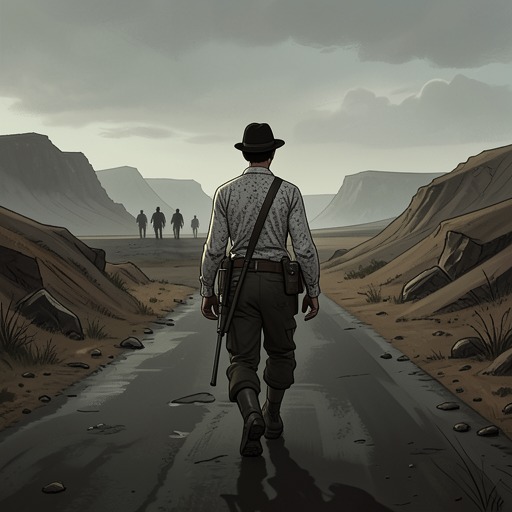
The boys’ report confirms that the highway to Los Angeles is damaged but usable. They encounter only a few minor washouts and landslides, which the jeep can negotiate in four-wheel drive. Those obstacles are real, yet they do not prevent the expedition from reaching the city. The old road network has not vanished altogether; it has become a route that demands a vehicle, caution, and the ability to respond to local damage.
After leaving Los Angeles, the boys take Route 66 east, following a road Ish himself had traveled in the days after the Great Disaster, when he was not much older than they are. The stretch across the desert is open apart from occasional drifts of blown sand and a few tire blowouts. The bridge over the Colorado River is shaky but passable. This sequence places Los Angeles at the western end of a route that still connects distant regions, even as each leg carries its own hazards and signs of decay.
Survivors and competing forms of community
The expedition’s news establishes that people live both in groups around Los Angeles and in smaller, scattered settlements. Charlie, whom Bob and Richard picked up near the city about ten days before arriving home, had been living alone. The detail makes Los Angeles more than a destination on an empty map: its surroundings hold people, but survival has not necessarily drawn them into a shared community. Charlie’s presence also brings an individual from that fragmented human landscape into Ish’s group, though the evidence here does not establish the circumstances of his life in the city itself.
The boys also report a community of religious fanatics living in Los Angeles. They wear white nightgowns and call themselves the People of God. Ish assumes that their religious focus reflects the influence of a strong leader who survived the disaster. He contrasts their development with that of The Tribe, which, in the absence of such a leader, acquired almost no comparable interest in religion. The contrast is Ish’s interpretation of how communities take shape under post-Disaster conditions: shared beliefs may be organized around leadership, while another group’s habits reflect the lack of it.
The account does not describe the Los Angeles group’s daily life or its relations with outsiders in detail. What it does reveal is a community with a conspicuous collective identity, set beside scattered survivors and a man found alone. Los Angeles is therefore not represented as having a single post-Disaster order. Different ways of living coexist in and around the same former center, and the expedition encounters only a portion of that changed human landscape.
A test of contact and memory
Los Angeles matters to Ish’s plans because finding other people would answer a practical question about who survived, but contact also raises questions about vulnerability. In a conversation with Em, Ish argues that people facing an unfamiliar arrival might be better prepared if they had sent scouts ahead. He invokes the disastrous consequences of contact between Indigenous peoples and white settlers, and between people on the African coast and enslavers. His point is that ignorance does not protect a community from forces approaching it. The expedition’s search gives that belief a concrete, if limited, form: the boys travel outward to learn what communities exist beyond their own.
Yet the city’s map and the boys’ report do not deliver a simple recovery of the past. The old routes remain recognizable, but the people who inhabit Los Angeles have formed new arrangements, and the surrounding terrain has altered roads and landscapes. Ish’s remembered geography and the expedition’s firsthand discoveries meet without becoming identical. Los Angeles is significant in that gap: it is a familiar name that helps orient the search, a place where survivors have reorganized life, and a reminder that knowledge of the old world can guide a journey without restoring the world that produced it.